






A HISTORY OF WOOLLEN SOCKS

THE ENDURING LEGACY OF WOOLLEN SOCKS
From Ancient Necessity to Modern Marvel
Long before the invention of central heating, humans discovered one of nature's most remarkable materials for protecting their feet: wool. The story of woollen socks spans thousands of years, from rudimentary animal skins wrapped around Stone Age ankles to today's sophisticated Merino wool hiking socks. Yet despite centuries of technological advancement and the development of countless synthetic alternatives, wool remains the material of choice for anyone serious about foot comfort and performance.
Ancient origins: The first steps
The sock is one of the oldest forms of clothing still in use today. Cave paintings and archaeological finds suggest that around 5000 BC, our Stone Age ancestors created primitive foot coverings from animal skins, tied around their ankles with leather strips or pelts. These early socks served a fundamental purpose: protecting feet from harsh terrain and bitter cold.
By the 8th century BC, the Greeks had refined the concept, wearing socks called piloi made from matted animal hair. The Greek poet Hesiod mentioned these in his poem "Works and Days," noting they were worn under sandals—perhaps history's first documentation of what would become a perennial fashion debate.
The Romans took sock development further during the 2nd century AD. They began sewing pieces of fabric together to create fitted socks called udones, which closely resembled the modern garments we wear today. Archaeological evidence from Vindolanda, a Roman fort in Northumbria, includes a message on a Roman tablet that reads: "I have sent you pairs of socks from Sattua, two pairs of sandals and two pairs of underpants." Even two thousand years ago, warm socks were considered an essential comfort in Britain's damp climate.
The birth of knitted wool socks
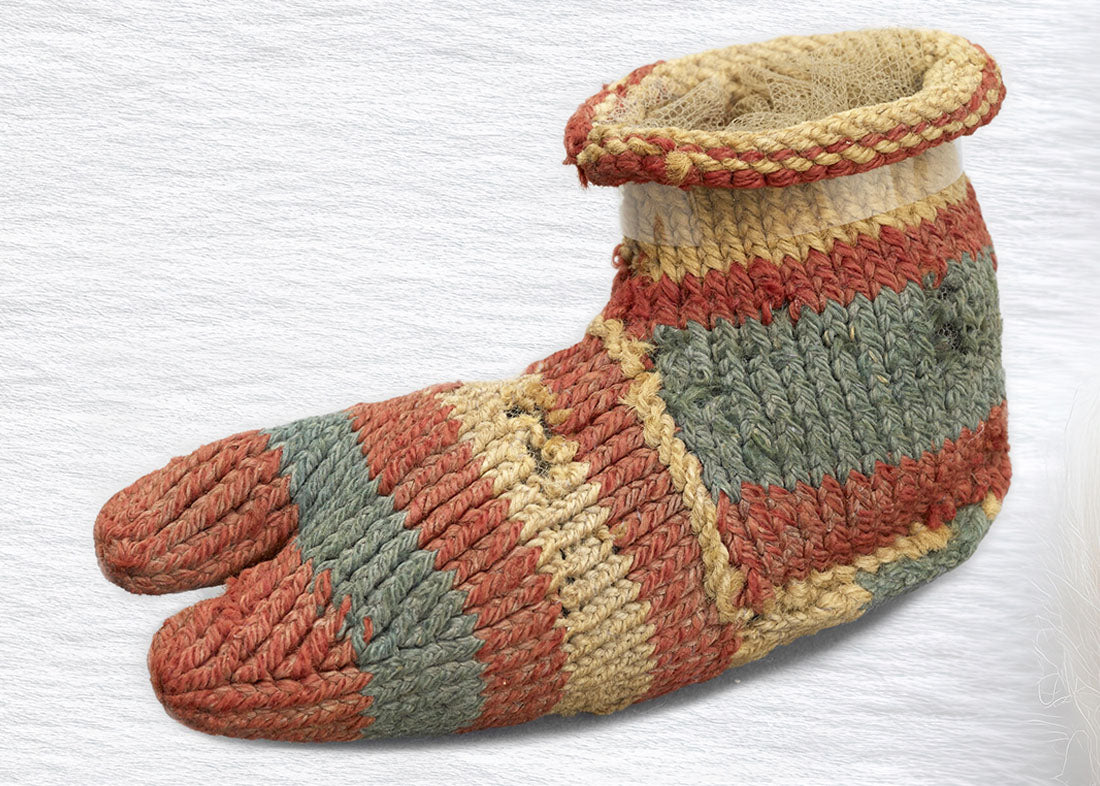
The first true knitted socks emerged in Ancient Egypt between 300 and 500 AD. Created using a technique called knotless netting, these woollen socks featured split toes designed to be worn with sandals. The oldest surviving pair, excavated from Oxyrhynchus on the Nile and dating from around 250 AD, showcases remarkable craftsmanship. Made from red wool and featuring seven different hues created from just three natural plant-based dyes, these socks demonstrate that even ancient sock-makers understood the appeal of colourful, well-crafted footwear.
The first woollen socks discovered in Britain date back to the 2nd century AD and were also found at Vindolanda.
Medieval status symbol to mass production
By the Middle Ages, socks had transformed from purely functional items into symbols of wealth and social standing. During the 11th century, knitted and woven socks became status symbols throughout Europe. Noblemen wore stockings made from fine fabrics like silk, often adorned with elaborate embroidery, while Europe's working classes knitted their own homespun woollen socks from coarser materials.
The invention of the knitting loom in 1589 by English clergyman William Lee marked a turning point in sock production. Though Queen Elizabeth I initially rejected his invention—she found the machine-made stockings too coarse for royal ankles—the technology eventually revolutionised the industry. By the time of the Industrial Revolution, woollen socks became easier and cheaper to produce, and their appeal spread across Europe and beyond.
London took sock regulation so seriously that in 1566, the city employed sock police — four officials positioned twice daily at the city gates to check that people entering or leaving wore proper hosiery. This fascinating historical footnote reminds us that socks have long been considered far more important than we might think today.
Why wool still reigns supreme
Despite the development of countless synthetic alternatives over the past century, wool—particularly Merino wool—remains the preferred material for quality socks. The reasons are rooted in wool's remarkable natural properties, refined over thousands of years of sheep evolution.
Temperature regulation/
Perhaps wool's most impressive quality is its ability to regulate temperature in both hot and cold conditions. Wool fibres naturally trap heat between their crimped structure, creating air pockets that provide insulation. Unlike synthetic materials, wool breathes, allowing moisture to escape while maintaining warmth. Merino wool socks can keep feet warm in temperatures as low as -10°C while keeping them cool in temperatures up to 30°C—a versatility no other material can match.
This thermoregulating ability stems from wool's unique structure. The natural crimp in wool fibres creates deep pockets of insulation that hold or release heat depending on what your body needs. Even when wet, wool maintains its insulating properties—it can absorb up to 30% of its weight in moisture while still feeling dry against your skin and continuing to keep you warm.v
Moisture management
One of wool's greatest advantages over cotton and synthetic alternatives lies in its moisture-wicking capabilities. When your feet sweat, wool naturally absorbs moisture before it turns into perspiration, then wicks it away from your skin to the sock's exterior where it evaporates. This keeps your feet drier, more comfortable, and significantly reduces the risk of blisters.v
Cotton, by contrast, acts like a sponge—it absorbs moisture and holds onto it, creating a damp environment that leads to discomfort and blisters. Synthetic materials may wick moisture away, but they lack wool's ability to maintain comfort and temperature regulation while doing so.
Natural antimicrobial properties
Wool possesses inherent antibacterial properties that prevent the growth of odour-causing bacteria. Even after prolonged use—multiple days of hiking, for instance—wool socks resist developing unpleasant odours. This makes them ideal for multi-day outdoor adventures, travel, or anyone who wants socks that stay fresher longer between washes.
The same natural properties that resist bacteria also mean wool requires less frequent washing than cotton or synthetic socks, making it both more convenient and more environmentally sustainable.
Durability and longevity
Quality wool socks, when properly cared for, can last for years. The natural elasticity of wool fibres allows them to stretch and return to their original shape repeatedly. Merino wool fibres, despite being one-third the diameter of a human hair, are incredibly resilient—they can be twisted up.
Comfort and softness
One of the historical drawbacks of wool was its tendency to feel itchy or rough against skin. Merino wool solved this problem. The fibres are significantly finer and less coarse than regular wool, making them soft enough to wear directly against skin without any irritation. This softness doesn't diminish when the socks get wet. Unlike cotton and synthetics, which can become abrasive and uncomfortable when damp, Merino wool maintains its gentle feel.
Sustainability
In an era increasingly concerned with environmental impact, wool offers distinct advantages. As a natural, renewable fibre, wool is biodegradable. A discarded wool garment will fully decompose in six months to five years. Synthetic alternatives can take hundreds of years to break down in landfills.v
Additionally, because wool naturally resists odours and stays cleaner longer, it requires less frequent washing, reducing water consumption and energy use over its lifetime.
The modern evolution
Today's wool socks represent the culmination of thousands of years of refinement. Modern manufacturing techniques combine traditional wool with advanced knitting technologies to create socks specifically engineered for different activities—hiking, running, everyday wear, or extreme cold weather conditions.
Merino wool has become the gold standard for performance socks. Its superfine fibres provide all the benefits of traditional wool while being lighter, softer, and more comfortable than ever before.
The next time you pull on a pair of Nundle woollen socks, you're not just choosing footwear, you're participating in a tradition that stretches back through human history. Your socks connect you to the Romans at Hadrian's Wall, the craftspeople of ancient Egypt, and countless generations who discovered that nature provides solutions that even our most advanced technology struggles to improve upon.
Nundle Wool & Yarns


